Designer’s Process: How Interior Designers Use Rug Patterns
Which pattern to go for? That’s a question that lingers a lot on my clients’. It’s not a problem, but rather a fun solution to look for.
The real problem here is placement. Where and how a pattern sits. How big or small it has to be to settle your space. But once you figure out what that particular rug needs to anchor, the answer comes automatically.
3 Questions to ask before choosing a pattern
| 1. what is this rug anchoring, the seating area, a dining table, a corner, a bed? |
| 2. are there strong patterns nearby, like art, wallpaper, tiles, that this rug is competing with? |
| 3. Personal taste + “classic & layered” or “architecturally clean”? |
Pattern placement v. Pattern choice
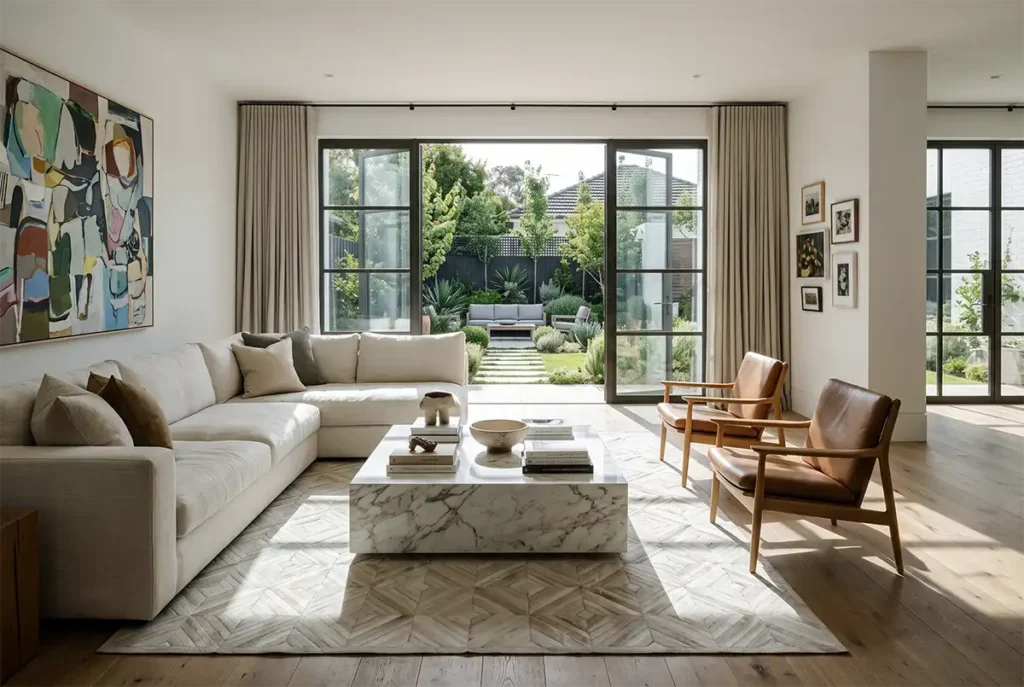
The first job of a rug is to anchor the space, not to sit under a coffee table like it was a last-minute decision on an Ikea run.
If (and believe me, this happens a lot) the sofa and chairs are floating around the edges, with their legs barely touching the rug, the room looks unfinished, empty, not designed. Even if you have the most gorgeous patterned rug there is.
I have a rule for this: AT MINIMUM, the front legs of every big furniture piece will rest on the rug. Size up to fit the whole of the furniture if you can, of course, but it’s not always possible, nor everyone wants it so. Just beware that a rug sized to the coffee table instead of the front legs of your sectional sofa isn’t just a small measuring error. It’s a scale mistake that WILL show.
So, to sum it up: get the size and placement right and the pattern becomes the easy part. A big room can handle a bold, large scale pattern because there’s enough space for the eye to read it properly.
On the contrary, a small or busy room needs a pattern that looks like texture from across the room and reveals itself up close.
That’s where a cowhide patchwork rug shines. On this decision.
Houndstooth for classic and transitional spaces
Houndstooth is my go-to for classic and transitional spaces. Molding, a mix of antique and modern pieces, wood tones, warm instead of gray. You know, that kind of room.
Why it works: Houndstooth has a history. It’s been in menswear and interiors for over a century (longer than any of us have been alive), it’s not trendy, even in a very current room. Also it is a small enough scale to behave like texture from across the room. Real detail once you get close. And I think that’s beautiful, adding that surprise element to the room.
Warm wood, leather seating, brass hardware… the houndstooth rug sits underneath it all, adding rhythm without shouting at the room.
And it’s forgiving. It’s not color-trend-tied, so you can update your pillows and decor items in five years, but your rug will still work.

Chevron and diamond for modern and industrial spaces
Chevron and diamond work differently than houndstooth. More graphic, more architectural. They love hard, clean lines to play against. A steel-framed window, an exposed brick wall… not a room full of soft edges.
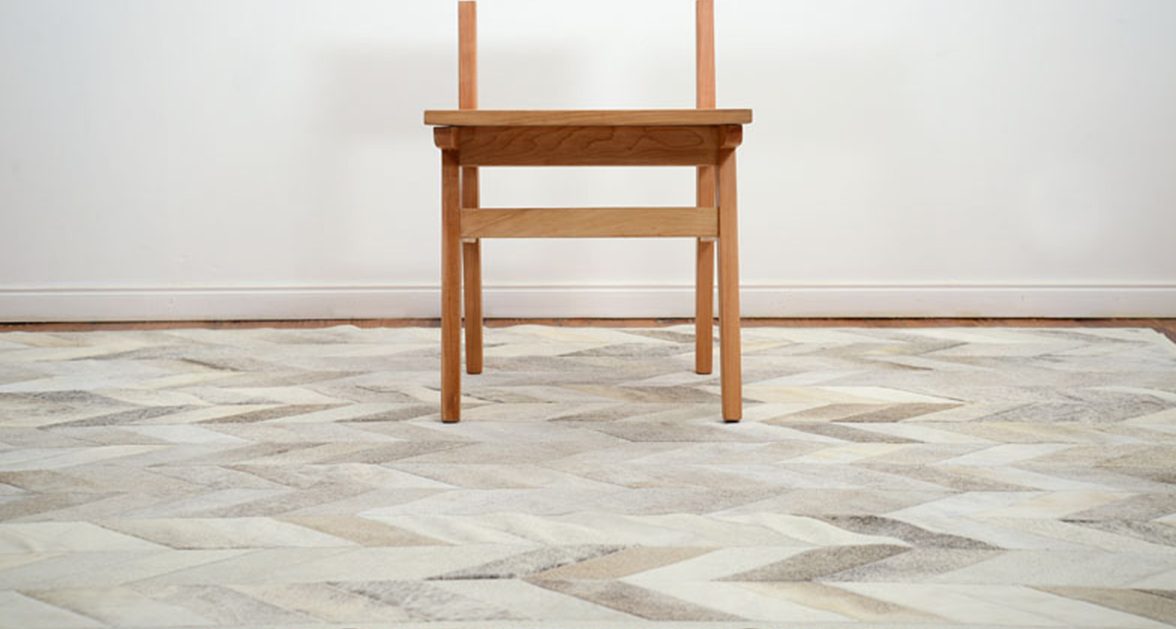
Chevron has direction. Energetically. The zigzag pulls the eye through the room, which is why it works almost everywhere, but an elongated room or hallways are the winners here.
Diamond is quieter, still geometric, and classic. It gives any room a luxury wink. It’s modern, but at the same time, strangely, classic. May I even call it… timeless?
Walking through the decision (no pun intended)
So how does this conversation go, when a designer calls about a real room?
First: the furniture that’s already committed or already ordered. That tells me what the rug has to work around.
Second: what’s the room missing? Not color. Texture and visual weight at floor level.
From there it’s scale. I ask for room dimensions and a rough furniture layout before pattern preference even comes up, because size narrows the options faster than taste does. A pattern that looks perfect in a photo can read completely different at 9x12ft versus 6×8 ft.
Only once size and placement are locked do we talk about which pattern fits the room’s personality: houndstooth, chevron, diamond, stripes, squares or a custom color story built around something else in the space. That’s the fun part. By then, the room’s already told us what it needs.
How our Trade Program supports custom sizing and color
This is what the Trade Program is built for. Every rug we make is made to order. A custom size, a color palette built to match a material that’s already a part of the room, that’s a normal Tuesday for us, not a special favor.
Working through the Trade Program means you’re not shopping a fixed inventory and hoping something close enough exists. You’re specifying the rug the way you’d specify any other custom element: size, color and pattern, built around the actual space instead of the other way around.
Let’s have that conversation!
Where this leaves you
Mid-decision on a rug right now? Staring at three good options, not sure which one’s right? Start with what the rug needs to anchor. That’s enough to break the tie.
Want it built to the exact size and color story your project calls for? We customize every rug. Contact us directly and we’ll help you even if you’re a designer, working with one, or just looking to find the perfect rug for your home. 🙂