
What Is Tadelakt? The Ancient Moroccan Plaster Technique, Explained
Long before “lime plaster” was popular, it was how Marrakech kept water in and out. Tadelakt is a traditional Moroccan wall finish that’s been in continuous use for centuries, and it’s having a real moment in modern interiors right now.
And I think that means so much in today’s world, where everything seems to be a cookie cutter copy of the previous thing. Having uniqueness in your home makes for a much more interesting and inspired life. Even if it a small, beloved trinket, or a big thing… as your actual walls.
We’ve put together a list of where tadelakt it comes from, what it costs, whether you can do it yourself, and how to find someone who can if you can’t.

The origins of tadelakt
Tadelakt traces back to northern Morocco, and specifically to Marrakech, where it was developed and used by the Berbers, the indigenous people of North Africa. The technique gained architectural prominence during the 11th century, under the Almoravid dynasty, meaning the walls you’re seeing in design magazines today are built on roughly a thousand years of refinement. Awesome.
The name itself tells you how it’s made: tadelakt comes from the Arabic verb dalaka (دلك), meaning “to rub” or “to knead”. That’s a direct reference to the burnishing process that gives the finish its signature soft sheen. The plaster isn’t just applied, it’s worked.
How tadelakt is made
Tadelakt is lime plaster, traditionally finished with black soap made from olives. The process, largely unchanged for centuries, runs through several distinct stages: calcareous stone is quarried and burned in traditional kilns, transformed into quicklime, slaked, and manually sieved.
The resulting plaster is applied to the wall with a cedar wood trowel, then smoothed and sealed by hand, burnished with black soap and polished with a river stone until the surface is watertight and faintly luminous.
No two tadelakt walls look identical, because none of it is mechanized. That handmade unevenness is exactly why we’re drawn to the material in the first place: it’s the same quality we build into every patchwork cowhide rug we make, if I may say so. Neither one comes off an assembly line, and put together, they help a room read as yours instead of a copy of the house down the street.
Why it was built for hammams
Tadelakt’s real superpower is impermeability. For centuries, Moroccan artisans used it to waterproof hammams (traditional bathhouses), fountains, and water cisterns: surfaces that needed to hold up to constant moisture with zero seams for water to exploit.
The waterproofing itself isn’t a synthetic sealant either: the reaction between the lime plaster and the black soap produces calcium stearate, a naturally water-repellent compound, which is why a well-applied tadelakt wall sheds water without any coating added on top.

Is tadelakt still used in Morocco today?
Yes, and it’s not just a nostalgic detail. Tadelakt is still considered the standard finish for hammams and riads across Morocco, and it shows up throughout boutique hotels and spas in Marrakech as both an authentic material choice and a mark of quality.
When historic riads are restored, conservation guidelines specifically call for traditional materials like tadelakt to protect the cultural identity of the buildings. It’s still the material Moroccan builders reach for when a wall genuinely needs to last.
There’s something quietly beautiful in that. A rule meant to protect old buildings ends up protecting a living skill, too: it means someone still has to learn tadelakt properly, hands-on, from someone who already knows it, instead of the craft quietly dying out in favor of a faster, more modern fix.
The city’s history stays standing, and the people who know how to keep it standing stay in business. That’s a rare kind of preservation, one that trains the next generation instead of just protecting what the last one built. Win-win, huh?
Bringing tadelakt into your home today
Tadelakt is best known for bathrooms and showers, and for good reason: it’s naturally waterproof, seamless, and warm underfoot in a way tile can’t match.
Its resistance to humidity and temperature swings also makes it a legitimate option outdoors, on exterior walls, courtyards, or covered patios exposed to rain and heat.
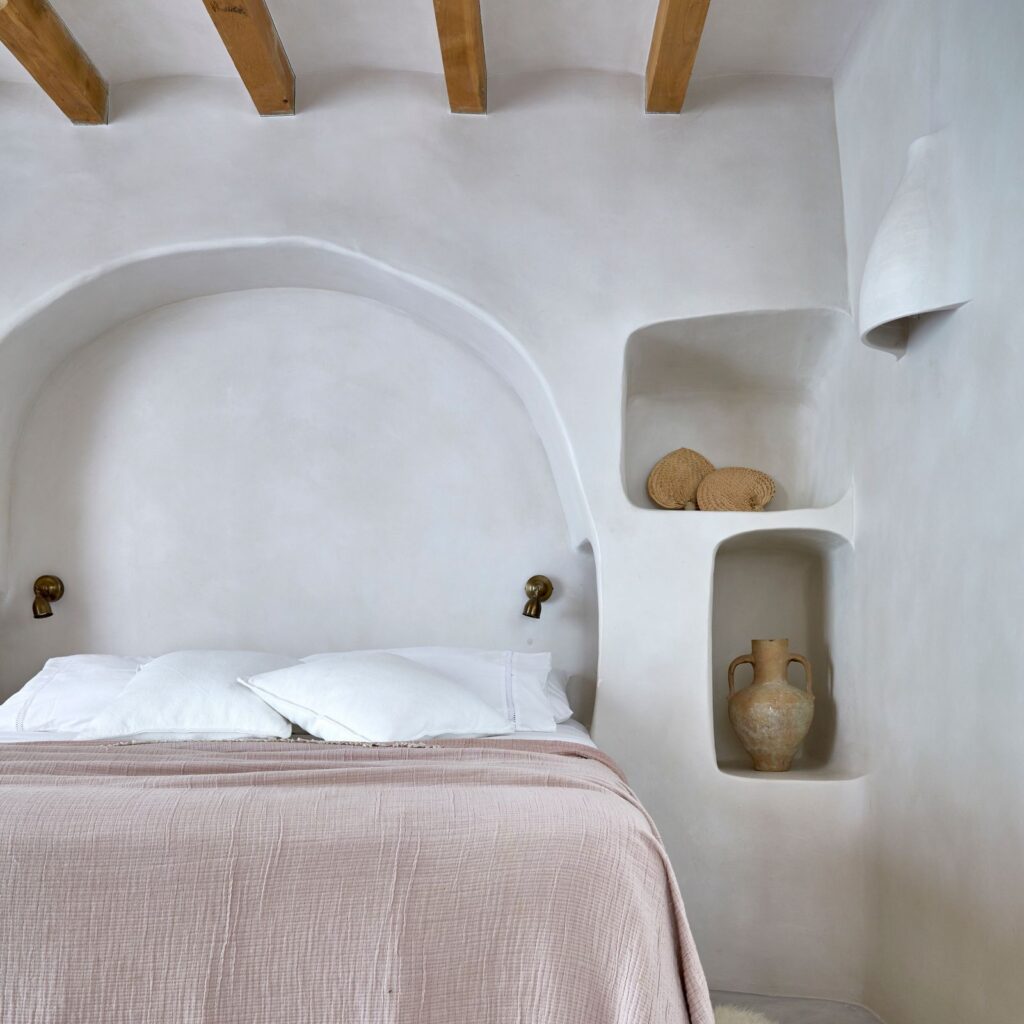
It’s not limited to wet rooms, as it also works beautifully as a feature wall, a kitchen backsplash, or full-room coverage anywhere you want a soft, matte-but-glowing texture without a single grout line.
Frequently asked questions about Tadelakt
Generally, yes. Professional tadelakt application typically runs $30 to $50 per square foot in wet areas, and can climb to $50 to $100 or more depending on complexity and location. That puts it above budget tile, though it’s genuinely competitive with imported or designer tile and often less expensive than luxury marble, with a finish tile can’t replicate since every tadelakt surface is hand-worked and seamless.
Technically, yes, but it isn’t a beginner weekend project. Tadelakt requires several thin base coats, precise timing on when to burnish, and a real feel for how your specific substrate absorbs water. DIY kits exist and can bring material costs down to roughly $5 to $10 per square foot, but the technique often requires plastering experience. If you’re set on doing it yourself, practice on a small, low-stakes surface before committing to a full bathroom.
Microcement. It’s cement-based rather than lime-based, applies in thin layers directly over existing tile, concrete, or wood, and costs less because the application process is faster and less specialized. You lose some of tadelakt’s soft, rounded, hand-burnished character in the trade, but it’s a solid budget-conscious way to get a similar look.
It depends on what you’re optimizing for. Tadelakt has the deeper history, the more tactile, velvety finish, and a fully natural, non-toxic composition. Microcement is faster to install, generally cheaper, and easier to apply over existing surfaces. Neither is objectively “better.” If budget and speed matter most, microcement wins. If you want the real, centuries-old material and are willing to pay for hand craftsmanship, tadelakt wins.
Yes, it’s arguably the material’s best-proven use case. It’s been used to waterproof wet spaces for centuries, resists mold thanks to its lime base, and creates a seamless surface with none of the grout lines that trap moisture and grime in a standard tiled shower.
Expect somewhere between $30 and $100 per square foot professionally installed, depending on the complexity of the space, your location, and the experience level of the plasterer. Material-only DIY costs are far lower, around $5 to $10 per square foot, but that doesn’t include the labor and expertise that make tadelakt look right 😉
How to hire a tadelakt specialist without getting burned
Because tadelakt is a specialized skill, not general plastering, the person you hire matters as much as the material. A few things worth checking before you sign anything:
- Ask specifically for a portfolio of tadelakt work, not general plastering or drywall jobs. The technique is different enough that experience with one doesn’t guarantee competence with the other.
- Ask how many base coats they plan to apply; a rushed job cutting corners on coats is one of the most common ways tadelakt fails early.
- Request references from past tadelakt clients you can actually contact, and ask how the finish has held up over time, not just how it looked on installation day.
- On the money side, be cautious of anyone asking for more than a 20 to 25 percent deposit up front, or anyone unwilling to put the scope of work and payment schedule in writing.
A quote that comes in dramatically lower than everyone else’s is usually a sign that corners will be cut somewhere you won’t see until the wall starts failing.
Good tadelakt work isn’t cheap, and that’s normal for a technique this labor-intensive.